
Civil engineering checklist for Auckland: compliant projects
- Jay Price
- 3 days ago
- 7 min read


Missing a single line item on your civil engineering checklist can cost an Auckland development weeks of delays, thousands in rework, and a stalled title issue. It happens more often than you’d think: a retaining wall inspection missed, as-built drawings submitted in the wrong format, or Watercare capacity left unchecked until it’s too late. A structured, Auckland-specific checklist keeps every compliance milestone visible and actionable. TCDC checklists are widely used as a model template for subdivision and development projects, and adapting that structure for Auckland Council requirements is exactly what this guide delivers.
Table of Contents
Key Takeaways
Point | Details |
Map every compliance stage | Understanding Auckland’s process ensures every task fits council and regulatory standards. |
Use a structured checklist | A clear, locally-tailored checklist prevents missed details and delays during construction. |
Tailor to your project needs | Adapt standard models with site- and council-specific requirements for full compliance. |
Anticipate obstacles early | Early checks on Watercare services, documentation, and inspections help avoid costly setbacks. |
Engage with experts | Working with Auckland-specialist civil contractors streamlines compliance from planning to completion. |
Understanding the Auckland civil engineering compliance process
To clarify what the checklist covers, let’s break down Auckland’s civil engineering compliance milestones. Every residential subdivision or development moves through a predictable sequence: feasibility, resource consent, engineering approvals, construction, inspections, and finally title issue. Understanding where each checklist item sits in that sequence is what separates a smooth project from a reactive one.
The subdivision process in Auckland follows these key stages:
Feasibility and pre-application — site constraints, zoning, servicing capacity, and geotechnical risks assessed.
Resource consent lodgement — planning documents, engineering reports, and drainage assessments submitted.
Engineering approval — civil engineering plans reviewed and approved by Auckland Council before construction begins.
Construction and inspections — staged council inspections at foundation, drainage, retaining, and completion phases.
As-built documentation — digital as-built drawings submitted post-construction for council review.
Section 224© certificate — engineering completion certificate issued, enabling title issue.
Civil engineering actions must align tightly with each of these stages. Submitting as-built drawings late, for example, holds up the Section 224© certificate and delays settlement. Understanding the engineering workflow across these stages helps you anticipate bottlenecks before they become problems.
Key insight: Watercare and utility checks should be integrated at feasibility, not after consent is granted. Capacity constraints in some Auckland areas can add months to a project timeline if left unconfirmed.
Documentation and scheduled council inspections are the backbone of compliance. Every stage requires a paper trail, and gaps in that trail are the most common reason projects stall. Getting your site preparation essentials right from the start sets the foundation for every subsequent compliance step. The civil subdivision process at Bromley Group is built around this staged compliance model.
The essential civil engineering checklist: item-by-item breakdown
Having mapped the process, let’s zoom into the specific checklist items needed at each compliance stage. These are grouped by project phase so you can track progress and assign responsibility clearly.
Project stage | Checklist item | Notes |
Engineering plans | Roading, drainage, water supply, earthworks, landscaping specs | Must be approved before construction |
Earthworks | Retaining wall design, erosion control plan, silt fencing | Geotechnical sign-off required |
Construction | Staged inspections booked, retaining compliance confirmed | Council inspector attendance required |
As-built drawings | Vector PDF and DWG format, NZTM coordinates, engineer sign-off | CCTV for stormwater pipes mandatory |
Asset certification | Schedule of vested assets, utility connections mapped | Field inspection required |
Final approvals | Engineering completion certificate, Section 224© lodgement | Triggers title issue |
Auckland Council’s as-built requirements specify vector PDFs, NZTM coordinates, and CCTV surveys for all new public stormwater pipes. These are non-negotiable. Submitting raster PDFs or missing CCTV footage will result in rejection and rework.
Key items to confirm before construction begins:
Engineering plans stamped and approved by Auckland Council
Geotechnical report reviewed and conditions noted
Erosion and sediment control plan in place
Watercare servicing confirmation received
Inspection schedule agreed with council
During construction, your site preparation checklist should run in parallel with your engineering compliance tracker. Silt fencing, retaining wall inspections, and drainage installation all require council sign-off at specific stages. Your stormwater and wastewater requirements must be documented and inspected before trenches are closed.
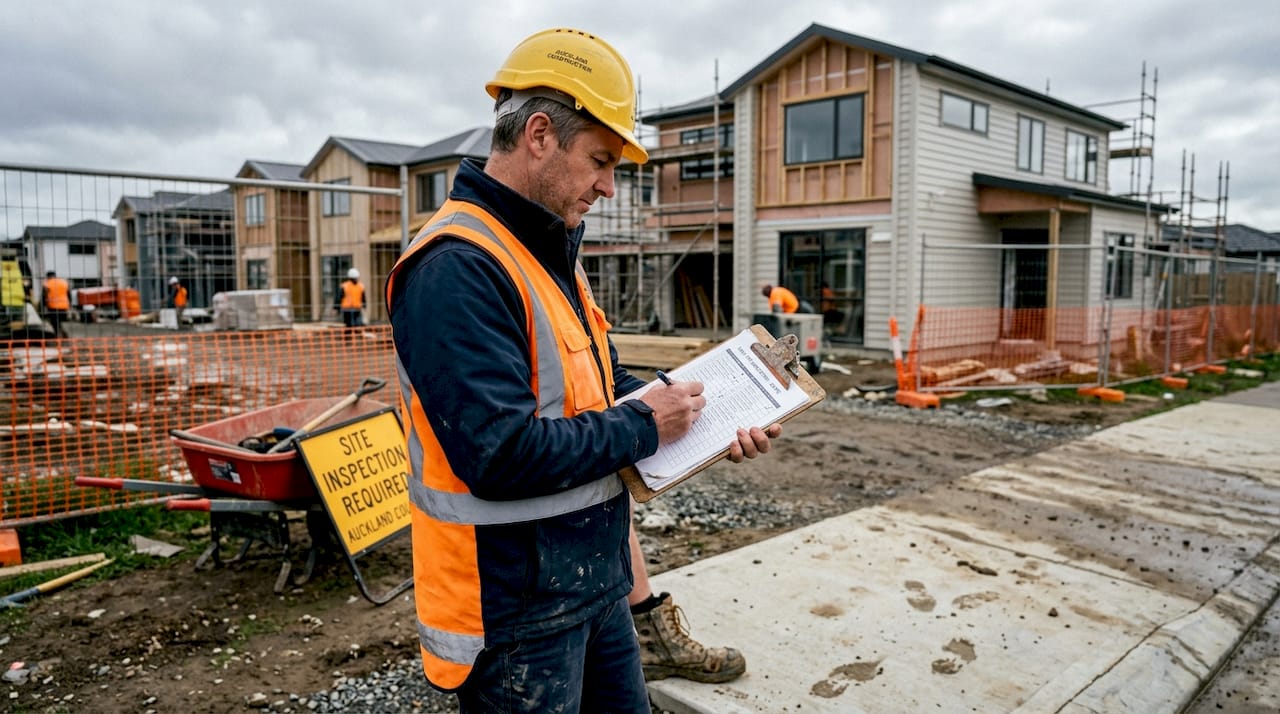
Pro Tip: Book your council inspections at least five working days in advance. Inspectors are in high demand across Auckland, and last-minute bookings frequently cause construction delays that cascade through your programme.
For a broader view of what civil engineering services typically cover across a development, the full service checklist is a useful reference point to cross-check your own scope.
Comparison: Standard checklists vs. tailored project requirements
Now that you know what to include, compare standard model checklists with site-specific or Auckland-specific requirements. Not every checklist item applies to every project, but knowing which additions are triggered by your site conditions is critical.
Checklist category | Standard model checklist | Auckland-specific requirements |
Roading | Geometry, kerb, channel, pavement specs | Auckland Transport design standards apply |
Drainage | Pipe sizes, gradients, inspection chambers | CCTV as-built mandatory for public pipes |
Water supply | Pipe material, pressure testing | Watercare approval and capacity confirmation |
Wastewater | Invert levels, connection points | Watercare network capacity check required |
Earthworks | Cut/fill volumes, compaction testing | Geotechnical report conditions must be met |
Landscaping | Species list, planting plan | Auckland Council Unitary Plan conditions may apply |
As-built drawings | Hardcopy or PDF | Vector PDF, DWG, NZTM coordinates mandatory |
The TCDC Code of Practice checklists are a solid model, but they must be adjusted for Auckland Council protocols. The digital submission requirements alone set Auckland apart from most other councils in New Zealand.
Site-specific triggers that require additional checklist items include:
Geotechnical risk zones — liquefaction-prone or steep terrain requires additional reporting and retaining design.
Watercare capacity constraints — some North Shore and East Auckland areas have limited network capacity, requiring early confirmation.
Special character or heritage overlays — additional consent conditions may apply under the Auckland Unitary Plan.
Large lot subdivisions — private stormwater management plans may be required in addition to public infrastructure.
Knowing when to supplement your checklist is a skill. Working with civil engineering specialists who understand Auckland’s local nuances saves you from discovering gaps mid-construction. Reviewing land development best practices before you start also helps you anticipate which additional items your project will need. A well-structured engineering plans guide can also help you verify your plan set is complete before lodgement.
Expert tips for avoiding delays and compliance setbacks
Equipped with the checklist, apply these expert tips to ensure a smooth, compliant project flow. These are drawn from real Auckland project experience, not theory.
Check Watercare capacity at feasibility. Watercare capacity constraints are a known delay risk in North Shore and East Auckland. Confirming capacity via GIS before lodging consent saves months of reactive problem-solving.
Keep all documentation digital from day one. Auckland Council requires NZTM coordinates and vector formats. Starting with analogue records and converting later introduces errors and delays.
Schedule inspections for every phase in advance. Retaining structures, drainage, and foundations all require formal inspections. Book them as soon as construction phases are confirmed.
Engage your certifying engineer early. Early feedback on engineering plans prevents last-minute redesigns. Your engineer should review draft plans before formal lodgement, not after.
Use Auckland Council’s model checklists as a baseline. The Auckland Council as-built requirements document is your primary reference. Cross-check every submission against it before lodging.
From the field: Projects that pre-book all staged inspections at the start of construction consistently close out faster than those that book reactively. It’s a small administrative step with a significant impact on programme.
Pro Tip: Assign one person on your team to own the compliance checklist. When responsibility is shared across multiple parties without a clear owner, items fall through the gaps. A single point of accountability keeps the checklist current and actioned.
Following land development safety tips alongside your compliance checklist ensures your site is both legally compliant and physically safe throughout construction. Engaging top civil contractors who are familiar with Auckland Council’s inspection expectations also reduces the risk of failed inspections and costly remediation.
Partnering with Auckland’s proven civil contractors
If you need hands-on support and local expertise, here’s how Bromley Group helps Auckland projects run smoothly. Navigating Auckland’s civil engineering compliance requirements is significantly easier when your contractor understands the process from the inside.
Bromley Group works with residential developers and builders across Auckland at every stage of the compliance process, from initial documentation and engineering plan review through to site execution, staged inspections, and as-built submissions. Our team specialises in subdivision civil works, earthworks, drainage, and retaining wall solutions that meet Auckland Council’s requirements. We understand what council inspectors look for, what documentation needs to be in place at each stage, and how to keep your project moving without compliance surprises. If you’re ready to get your next development on track, request a project quote and we’ll help you build a checklist and execution plan tailored to your site.
Frequently asked questions
What is a civil engineering checklist for Auckland projects?
It’s a project-specific list covering all planning, construction, inspection, and certification tasks required for Auckland Council compliance. The TCDC checklist structure is a suitable starting template, adjusted for Auckland’s specific digital and certification requirements.
Do I need CCTV inspections for stormwater pipes in residential developments?
Yes. CCTV for public stormwater pipes is mandatory under Auckland Council’s as-built requirements before trenches are closed and assets are vested.
How early should Watercare service capacity be checked?
Check at feasibility stage. Watercare capacity delays are a documented risk in constrained areas like North Shore and East Auckland, and early confirmation prevents consent-stage surprises.
What engineering documents are needed for compliance signoff?
You’ll need engineering completion certificates, digital as-built plans in PDF and DWG format, asset schedules, and signed certifications. Auckland Council mandates specific digital formats and coordinate systems for all submissions.
Are council inspections required at each construction phase?
Yes. All key stages including foundation, drainage, retaining walls, and final build require formal Auckland Council building inspections before work can proceed to the next phase.
Recommended