
Streamline your earthworks workflow for Auckland builds
- Jay Price
- Apr 9
- 8 min read

Updated: Apr 18
TL;DR:
Proper planning, site analysis, and verification are essential to prevent delays and cost overruns.
Following a strict earthworks sequence ensures quality and compliance in Auckland projects.
Engaging specialists and thorough documentation facilitate smooth transitions to subsequent construction phases.
Poor earthworks sequencing is one of the most common reasons Auckland construction projects run over time and over budget. A missed survey, a skipped compaction test, or a late consent approval can stall an entire site for weeks. For property developers, residential builders, and commercial project managers, that kind of delay has real financial consequences. This guide walks you through a practical, step-by-step earthworks workflow built around Auckland’s specific conditions, compliance requirements, and site realities. From early planning through to final sign-off, you’ll find the preparation checklists, sequencing advice, and verification steps you need to keep your project moving.
Table of Contents
Key Takeaways
Point | Details |
Thorough preparation | Early site analysis and risk checks prevent costly delays during earthworks. |
Follow the sequence | Sticking to a proven workflow from set-out to compaction ensures quality results. |
Plan for compliance | Certification and verification steps are essential for successful Auckland construction handover. |
Learn from common pitfalls | Avoiding frequent earthworks mistakes keeps projects on schedule and within budget. |
Getting started: prerequisites and early planning
Before a single machine rolls onto your site, the groundwork for a smooth project is laid in the planning phase. Start with a thorough review of your project brief, including scope, programme, and any design drawings. Understand exactly what consents and permits are required under Auckland Council’s rules, whether that’s a resource consent, building consent, or both. Getting this wrong early creates compounding delays later.
Site analysis is a critical first step for Auckland projects, particularly given the region’s varied geology, from Waitemata sandstone to volcanic basalt and heavy clay soils. A proper geotechnical investigation will identify bearing capacity, groundwater levels, and any unstable zones before you commit to a cut-and-fill strategy. Skipping this step is where many projects first go wrong.
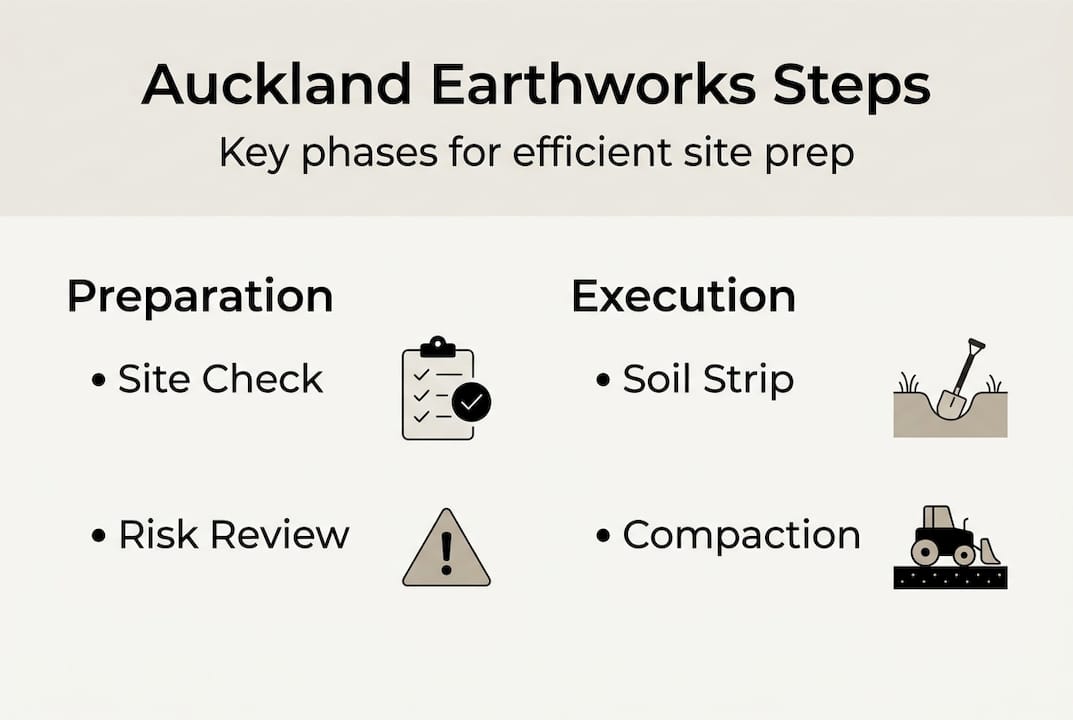
You’ll also need to understand your earthworks terminology before briefing subcontractors or reviewing quotes, as misaligned expectations around terms like cut, fill, compaction, and spoil disposal can lead to scope disputes.
Tool or document | Purpose |
Geotechnical report | Soil classification and bearing capacity |
Site survey (cadastral) | Legal boundaries and levels |
Underground services plan | Locate power, gas, water, and telecoms |
Resource or building consent | Legal authority to proceed |
Erosion and sediment control plan | Required by Auckland Council |
Excavator and compaction equipment | Primary earthmoving machinery |
GPS or laser level equipment | Accurate set-out and grading |
Before breaking ground, check for the following site risks:
Underground services: Water mains, gas lines, telecoms, and stormwater pipes are often unmarked or inaccurately mapped
Unstable or fill land: Previous land use may have left unconsolidated fill that won’t support structures
Contamination: Former industrial or agricultural sites may require soil testing and remediation
Flooding and drainage: Low-lying areas or sites near waterways need careful stormwater planning
Steep slopes: Erosion risk increases significantly on grades above 1:4
Pro Tip: Contact Auckland Council’s duty planner and Watercare early in your project. Getting pre-application advice costs very little but can save weeks of back-and-forth during the consent process.
Step-by-step earthworks workflow for Auckland projects
With planning and prerequisites in hand, you’re ready to begin the practical, stepwise earthworks process, adapted for Auckland’s conditions. The earthworks process follows a set sequence from site cut through compaction and sign-off, and deviating from this order is a reliable way to create expensive rework.
Site set-out: Establish control points using GPS or laser levels. Mark boundaries, cut lines, and fill zones clearly. This step locks in your design intent on the ground.
Topsoil strip: Remove and stockpile topsoil separately. In Auckland, this material is often reused for landscaping or sold, so handle it carefully to preserve its value.
Bulk earth removal: Execute the primary site cut process using excavators and dump trucks. Manage spoil volumes carefully to minimise double-handling.
Subgrade preparation: Scarify and moisture-condition the exposed subgrade before any fill placement. Auckland’s clay soils are particularly sensitive to moisture variation.
Engineered fill placement: Place and compact fill in controlled layers, typically 150 to 200 millimetres per lift. Use material that meets your geotechnical engineer’s specification.
Grading and trimming: Bring the site to finished levels, ensuring correct falls for drainage. Check against design drawings at every stage.
Compaction verification: Test compaction using a nuclear density gauge or dynamic cone penetrometer. Document results for council sign-off.
Method | Best for | Pros | Cons |
Manual excavation | Small, confined sites | Precise, low disturbance | Slow, labour-intensive |
Mechanised excavation | Medium to large sites | Fast, cost-effective | Requires access and space |
Safety note: Auckland’s weather can change rapidly. Wet conditions make slopes unstable and can cause equipment to slip or overturn. Always reassess site safety after significant rainfall before resuming work.
Pro Tip: Tie your inspection schedule to workflow milestones, not just calendar dates. Inspect after topsoil strip, after bulk cut, and after each fill lift. This catches problems before they become expensive.
The site preparation steps must be completed in sequence. Rushing ahead to the next stage before verification is complete is the single most common cause of rework on Auckland sites.
Troubleshooting and avoiding common earthworks mistakes
Once workflow is underway, knowing what can go wrong is vital for staying on track and within budget. Cost overruns and timeline issues often stem from overlooked risks that were identifiable before work began. The good news is that most of these problems are preventable with the right habits.
The most common mistakes we see on Auckland sites include incomplete or outdated site surveys, improper compaction leading to settlement, underestimating the impact of Auckland’s wet winters, and poor spoil management that results in double-handling costs. Each of these is avoidable with disciplined pre-task planning.
Watch for these symptoms that signal something is going wrong:
Soft spots or rutting under machinery, which indicates inadequate compaction or wet subgrade
Excess spoil volumes that weren’t anticipated, pointing to inaccurate survey data
Ponding water on the platform, which means grading falls are incorrect or drainage is blocked
Cracking or slumping on cut faces or fill batters, indicating slope instability
Unexplained delays in subcontractor mobilisation, often caused by late consent approvals
Understanding civil construction challenges in New Zealand’s regulatory environment is essential for anticipating these issues before they escalate.
Pro Tip: Use moisture content testing alongside compaction testing. A result that meets density requirements but is outside the optimum moisture range is a future settlement risk. Test both, every time.
Compliance note: Auckland Council has strict reporting requirements for earthworks, particularly around erosion and sediment control. Failure to maintain compliant sediment fencing and reporting can result in stop-work notices and fines. This is not an area to cut corners.
For residential earthworks mistakes, the consequences are often felt at the foundation stage when differential settlement or drainage failures become apparent. Build a contingency of at least 10 to 15 per cent into your earthworks timeline and budget. Weather delays alone justify this buffer in Auckland’s climate.
Verifying quality and compliance on your site
With awareness of pitfalls, the final key is ensuring your work stands up to scrutiny and regulatory checks. Verification is compulsory for Auckland builds to ensure safe completion and to unlock the next stage of construction. Skipping or rushing this phase creates liability for every party on the project.
Key inspection points to check before signing off earthworks:
Finished levels: Confirm all platforms, batters, and drainage falls match the approved design
Compaction results: All test results must meet the specified standard, typically 95 per cent of modified Proctor density
Drainage installation: Subsoil drains, stormwater connections, and surface falls must be functioning correctly
Erosion controls: Sediment fencing, stabilised entry points, and exposed soil management must comply with the approved plan
Documentation: All test results, inspection records, and as-built drawings must be compiled and ready for submission
In Auckland, virtually all residential and commercial earthworks require council sign-off before the next construction phase can proceed. This makes documentation as important as the physical work itself.
Document or certification | Issued by | Required for |
Compaction test report | Geotechnical engineer | Foundation consent |
As-built survey | Licensed cadastral surveyor | Council sign-off |
Producer statement (PS4) | Engineer of record | Code compliance |
Erosion control completion report | Site supervisor | Resource consent close-out |
For a full overview of site compliance checks and the handover steps required before construction continues, ensure your team has a documented handover checklist that travels with the project file from day one.
Why Auckland earthworks workflows succeed or fail: our expert view
After working across Auckland’s residential and commercial construction sector, we’ve noticed that the gap between smooth projects and troubled ones rarely comes down to technical skill. It comes down to communication discipline and the willingness to verify before progressing.
The biggest missed opportunity we see is teams skipping the pre-task brief. Five minutes before each shift to confirm today’s scope, who’s responsible for what, and what the sign-off criteria are prevents hours of rework. Subcontractors who aren’t involved in planning until the day they arrive are another consistent problem. Bring them into the conversation during the design phase, not the execution phase.
The ‘tick-box’ approach to compliance is also worth calling out. Doing the minimum to satisfy council requirements often results in rework later, because minimum compliance and genuine quality are not the same thing. Our view is that embedding quality at every stage, not just at inspection points, is what makes Auckland earthworks expertise genuinely valuable. Projects that treat verification as a final hurdle, rather than a continuous habit, are the ones that call us in to fix problems after the fact.
Partner with earthworks specialists for seamless project delivery
If you’re managing an Auckland build and want to eliminate the guesswork from your earthworks workflow, working with a proven local contractor makes a measurable difference. Bromley Group brings integrated capability across the full project lifecycle, from initial site preparation through to final compliance handover.
As Auckland earthworks contractors, we handle site cuts, bulk earthmoving, drainage installation, and retaining wall specialists solutions under one roof. That means fewer coordination gaps, cleaner documentation, and faster sign-off. Whether you’re starting a subdivision, a commercial development, or a residential build, we’re ready to support your project from the ground up. Request a quote today and let’s talk through your site requirements.
Frequently asked questions
What are the key steps in an Auckland earthworks workflow?
The main steps are site analysis, set-out, stripping topsoil, bulk earth removal, grading, compaction testing, and final verification. Each step must be completed and checked before the next stage begins to avoid rework.
How can I avoid cost overruns on earthworks?
Start with a thorough site analysis and factor in risks like weather delays, underground services, and compliance requirements. Most cost overruns stem from overlooked risks and poor planning, so always include a contingency buffer in your budget.
Who is responsible for earthworks compliance in Auckland?
The builder or project manager must coordinate with certified contractors and engineers to meet council and regulatory sign-off requirements. Verification is compulsory before construction can advance to the next phase.
What documents are required before starting earthworks?
You need site surveys, resource or building consents, an erosion and sediment control plan, and documentation of existing underground services. Site analysis and documentation are the foundation of a compliant and efficient project start.