
How to manage concrete works for Auckland projects
- Jay Price
- 4 hours ago
- 6 min read

TL;DR:
Poor management of concrete works can lead to costly repairs and compliance issues.
Proper site preparation, compliance, execution, and documentation are essential to ensure quality and timely completion.
Early geotechnical assessment and thorough project management reduce risks and prevent common mistakes.
Poorly managed concrete works are one of the most expensive mistakes you can make on an Auckland construction project. Cracked slabs, failed foundations, and blown-out timelines are not just inconvenient; they cost thousands to rectify and can expose you to serious compliance liability. Getting concrete right depends on a clear, sequenced approach that covers compliance, site preparation, execution, and handover. This article walks you through each stage so your next concrete project runs on time, on budget, and to standard.
Table of Contents
Key Takeaways
Point | Details |
Compliance is essential | Only Licensed Building Practitioners should manage structural concrete for legal and safety reasons. |
Planning prevents mistakes | Site preparation, sequencing, and scheduling save time and cut cost overruns by up to 20%. |
Meet quality benchmarks | Check slump, air content, and curing times to ensure durable results for Auckland projects. |
Document every step | Good records and prompt troubleshooting help avoid disputes and speed up sign-off. |
Understanding regulations and compliance
Before a single cubic metre of concrete is placed, you need to understand what the law requires. In New Zealand, foundations and structural concrete are classified as restricted building work, which means only a Licensed Building Practitioner (LBP) can carry out or supervise that work. This applies to foundations, structural slabs, and any concrete element that contributes to the structural integrity of a building.
Meeting concrete contractor requirements is not just a legal formality. It directly affects your ability to get a Code Compliance Certificate (CCC) at the end of the project. If the work is completed without an LBP, councils can decline to issue a CCC, leaving the property in a legally compromised state that creates real problems at settlement or resale.
Key compliance obligations for concrete works include:
Confirming whether your project triggers restricted building work before work begins
Engaging a qualified LBP to carry out or supervise structural concrete
Obtaining all required building consents prior to pouring
Keeping records of inspections, test results, and LBP sign-offs throughout the project
Ensuring council inspections occur at the required hold points
“Skipping LBP requirements is never worth the short-term saving. The cost of retrospective compliance, or worse, demolition and repour, will always outweigh the upfront investment in doing it right.”
Our guide to safe concrete structures covers the structural requirements in more detail if you want to go deeper on this topic.
Preparing your site and staging the work
Once you understand your compliance obligations, it is time to prepare the ground for a successful pour. Site preparation is where projects are won or lost. Rushing this phase is the single biggest cause of concrete failure in Auckland’s variable soil and weather conditions.
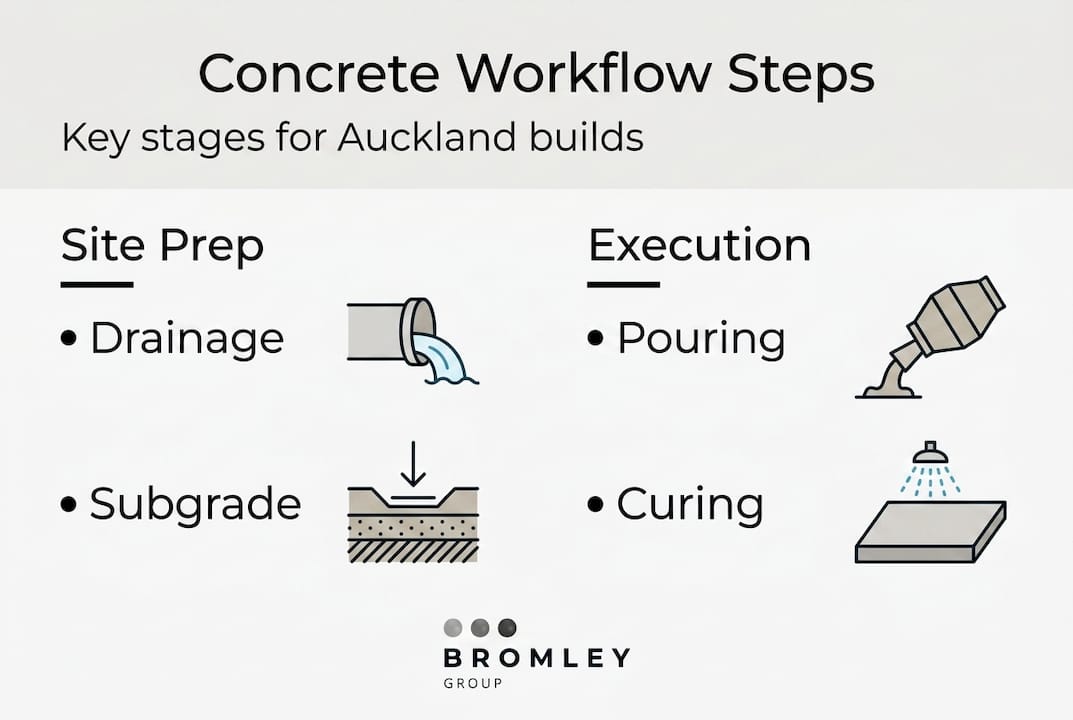
Effective project management reduces cost overruns by 15 to 20% and improves timelines by 10 to 15%, and the sequencing of earthworks and drainage before any concrete is poured is central to achieving those results.
Here is a reliable preparation sequence for Auckland concrete projects:
Complete bulk earthworks and site cuts to finished subgrade level
Install drainage systems and subsoil drainage where required
Compact subgrade to specified bearing capacity
Place and compact hardfill or base course material
Install formwork, reinforcing steel, and service penetrations
Arrange council or engineer inspections before pouring
Pro Tip: Auckland’s wet winters create serious risks for fresh concrete. Schedule pours during drier months where possible, and always have poly sheeting and temporary shelter on standby. A pour rained on within the first few hours can lose significant strength.
For deeper guidance on sequencing earthworks, the earthworks workflow strategies resource is worth reviewing alongside your earthworks terminology guide to make sure your team is working from the same language.
Preparation task | Risk if skipped |
Drainage installation | Saturated subgrade, slab heave |
Subgrade compaction | Differential settlement, cracking |
Formwork inspection | Blowouts, dimensional failure |
Reinforcing check | Structural non-compliance |
Executing concrete works: best practices
With the site ready, precision in execution ensures your concrete work meets or exceeds standards. Mixing, placing, and finishing concrete sounds straightforward, but the margin for error is narrow on commercial and residential development sites.
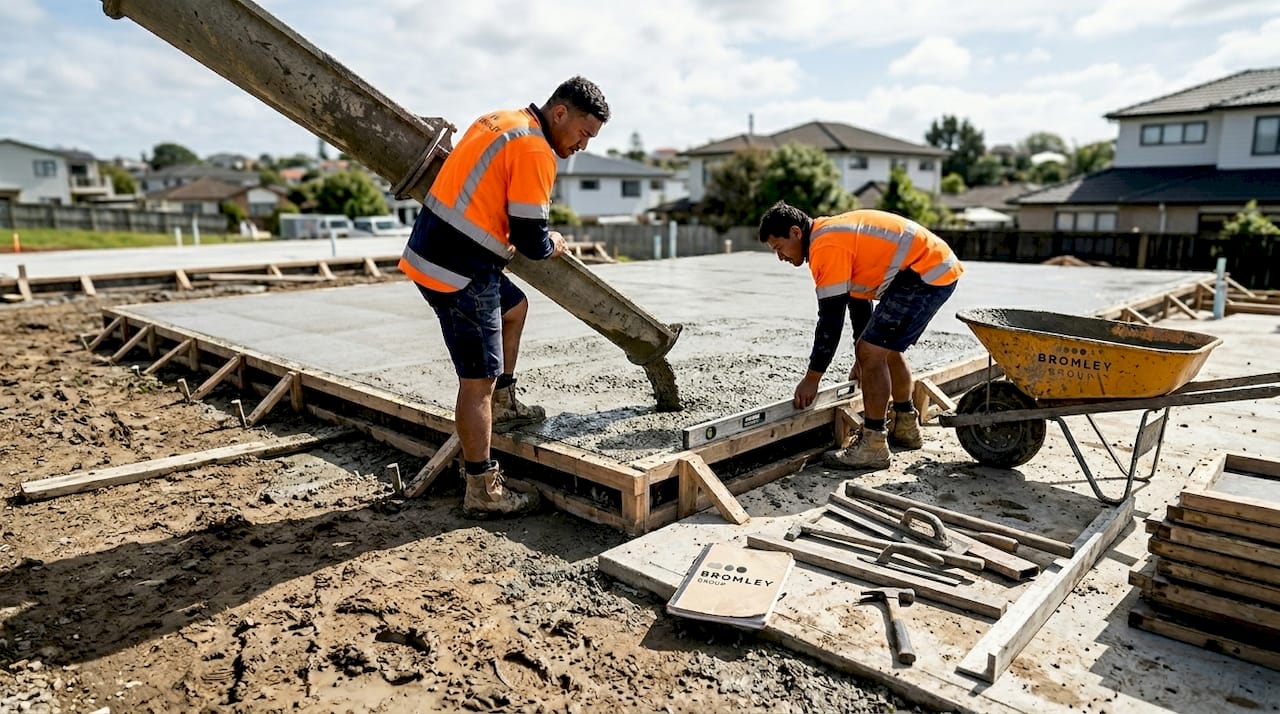
The NZ Concrete Specification benchmarks set clear quality thresholds: slump tolerance of ±30mm from the specified value, air content of 4 to 6% for moderate exposure environments, and a minimum curing period of 7 days for adequate strength development. These are not guidelines; they are the standard your project will be measured against.
A practical execution sequence for concrete pours:
Confirm mix design and delivery dockets match the specification
Test slump and air content from the first truck and at regular intervals
Place concrete in layers and vibrate thoroughly to eliminate voids
Finish to the specified level and surface texture
Apply curing compound or wet hessian immediately after finishing
Protect from rain, direct sun, and foot traffic during the curing period
Pro Tip: Keep a pour log. Record truck arrival times, slump test results, air content, ambient temperature, and the name of the LBP supervising. This documentation protects you if defects are later disputed and is required for compliance purposes.
The concrete best practice guide goes into further detail on mix designs and placement techniques specific to Auckland conditions. For broader project coordination, effective construction project management strategies will help you coordinate trades and inspections efficiently.
Quality assurance, troubleshooting and handover
After pouring, a solid handover and problem resolution process protects your investment and reputation. Quality assurance is not a single inspection; it is an ongoing process from the first day of curing through to final handover.
Use this checklist when inspecting finished concrete:
Surface finish: consistent texture, no honeycombing or exposed aggregate
Levels: within tolerance specified on drawings
Cracking: hairline cracks may be acceptable; structural cracks are not
Joints: control joints installed at correct spacing and depth
Drainage: water sheds as designed, no ponding
Common defects and their remedies include surface crazing from premature drying (addressed with curing compound reapplication), plastic shrinkage cracking from wind or heat (prevented with windbreaks and timely finishing), and honeycombing from poor vibration (requiring cut-out and re-patching with approved repair mortar).
“Unresolved defects at handover are far more costly than fixing them on the spot. Clients who receive a defect-free project become repeat clients. Those who receive a list of outstanding issues rarely do.”
Strong project management practices at handover mean providing the client with a complete package: as-built drawings, test records, LBP sign-offs, and a clear defects liability process. Good documentation also reinforces concrete structural integrity over the long term. That package, combined with proactive communication, is what separates professional contractors from the rest.
What most Auckland builders get wrong about managing concrete works
Most contractors focus their energy on the pour itself, and that is understandable. It is the visible, high-pressure moment. But in our experience, the projects that go wrong almost always trace back to decisions made weeks earlier, not on the day of the pour.
Auckland’s ground conditions vary enormously across even short distances. Volcanic soils, filled ground, and clay-heavy profiles each behave differently under load and moisture. Treating every site as if it has standard subgrade is a mistake we see repeatedly. Early geotechnical input is worth every dollar.
Documentation is equally underrated. Contractors who maintain thorough records throughout the project resolve disputes faster, pass inspections more easily, and build better client relationships. For consistent results, solid project management discipline applied from day one is the real differentiator.
Take the next step with trusted Auckland concrete specialists
If you’re ready to deliver your next concrete project with confidence, Bromley Group offers end-to-end support across every phase.
[
From expert concrete contractors managing foundations and slabs to earthworks and site prep that sets your project up correctly from the start, and drainage specialists who keep groundwater from undermining your work, we handle the full scope. Our Auckland-based team understands local ground conditions, council requirements, and how to keep projects on schedule. Get in touch to request a quote or arrange a site visit.
Frequently asked questions
What is the most common mistake when managing concrete works in Auckland?
Rushing site preparation or skipping adequate curing are the most frequent errors. Curing for 7 days is the minimum for concrete to reach reliable structural strength.
Do I legally need a Licensed Building Practitioner (LBP) for concrete slabs?
Yes. In New Zealand, slabs and foundations are restricted building work and must be carried out or supervised by a licensed LBP.
How can I minimise delays and budget overruns in my concrete project?
Proper sequencing and effective project management of earthworks and drainage before concrete pours reduces cost overruns by up to 20%.
What quality benchmarks should I ask my contractor for?
Ask for slump tolerance within ±30mm, air content of 4 to 6%, and confirmation that concrete was cured for at least 7 days before loading.
Recommended