
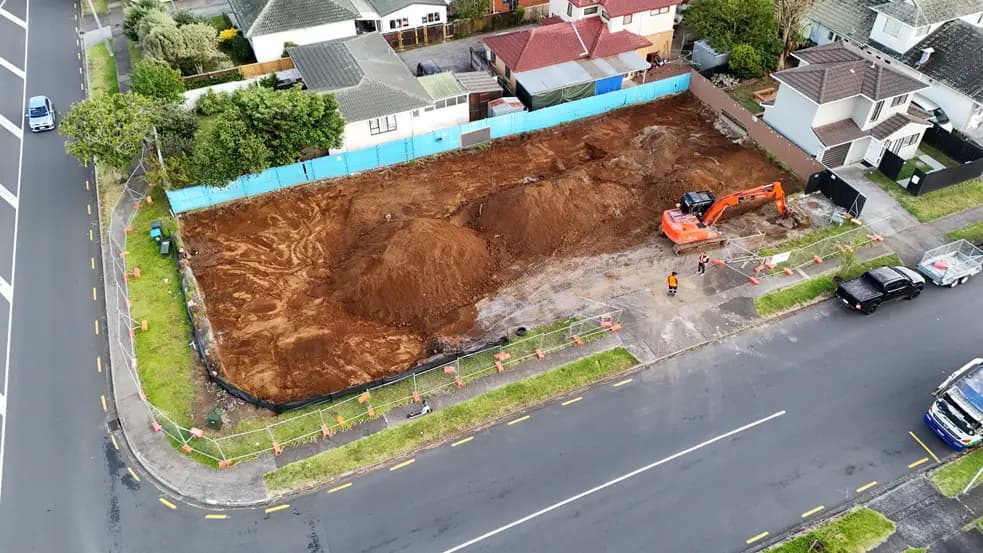
If you are planning a house build, subdivision, or significant site works in Auckland, the earthworks season is one of the most important planning constraints you need to know about. Under the Auckland Unitary Plan, bulk earthworks are generally restricted to the period between 1 October and 30 April each year. Outside this window, earthworks beyond certain thresholds require additional resource consent conditions, particularly around erosion and sediment control. This is general guidance only - the rules that apply to your specific site depend on your zone, overlays, and the activity itself, so check your resource consent conditions or speak with a planning consultant to confirm what applies to your project.
Why the earthworks season exists
Auckland receives the majority of its rainfall between May and September. During this period, disturbed ground is far more susceptible to erosion. Sediment runoff from earthworks sites is one of the leading causes of water quality issues in Auckland's streams, harbours, and coastal areas.
The seasonal restriction is Auckland Council's primary tool for managing this risk. By concentrating bulk earthworks within the drier summer months, the likelihood of significant sediment discharge is reduced. For experienced contractors, working within the season is standard practice. For property owners and developers new to the consent process, the implications can catch them out.
What is restricted and what is not
The restriction applies to bulk earthworks above certain volume thresholds. Activities that typically trigger the seasonal rule include:
- Earthworks exceeding 250m³ on a single site
- Any earthworks within 10 metres of a waterway
- Works on sites with slopes over approximately 15 degrees
- Earthworks associated with a subdivision or development requiring resource consent
Smaller residential jobs, such as a driveway excavation or a minor retaining wall foundation, typically fall below the threshold and can proceed year-round. If your project is consent-notified or involves a development site, your engineer or planner will specify which earthworks season conditions apply. These thresholds are a general guide - your site's specific overlays, slope, and proximity to waterways can bring a smaller job into scope, so confirm the position for your site before assuming a project is exempt.
What this means for your project timeline
Planning to build this summer?
If your house is targeting a pre-Christmas or January slab pour, earthworks need to be completed well before that. The standard sequence is: earthworks, drainage, subgrade preparation, then concrete. If your earthworks crew is not booked by October, the pour date slips.
The critical bottleneck is usually resource consent timing. Auckland Council non-notified consent processing takes a minimum of 20 working days, and more complex applications regularly run longer. Add pre-application meetings, plans preparation, and engineer engagement, and you can easily be looking at three to four months from decision to start on site.
Rule of thumb: If you want earthworks completed by November or December, your consent application should be lodged no later than July or August.
Planning a subdivision?
Subdivision civil works almost always require resource consent, and the earthworks conditions imposed will reference the season directly. The bulk earthworks programme for your development must be planned to be completed within the season, or alternatively staged across multiple seasons with appropriate erosion and sediment control measures in place.
For larger developments, this often means prioritising cut-and-fill work and roading formation in the first season, with services, drainage, and finishing works carried into a second season if needed.
What if works run past 30 April?
If bulk earthworks are still underway at the end of April, you are not automatically required to stop. However, your resource consent conditions will specify what is required, and this typically includes enhanced erosion and sediment control measures such as:
- Sediment retention ponds
- Silt fences and hay bale barriers
- Stabilised construction entrances
- Staged progressive revegetation
These measures add cost and require ongoing monitoring. Planning your programme to complete within the season avoids these requirements in most cases.
Erosion and sediment control: contractor responsibilities
Under Auckland Council's erosion and sediment control guidelines, your earthworks contractor is responsible for implementing and maintaining ESC measures for the duration of works. Temporary sediment controls are installed at the start and maintained throughout the job. On larger consented projects, the ESC plan is specified by your civil engineer as part of the consent application, and the contractor is required to implement that plan and report on its effectiveness.
This is standard practice for Bromley Group across all earthworks projects in Auckland, regardless of size. It is not an optional extra.
Key dates at a glance
| Date / Period | What it means for your project |
|---|---|
| 1 October | Bulk earthworks season opens in Auckland |
| 30 April | Bulk earthworks season closes |
| July / August | Latest recommended time to lodge a resource consent for a November start |
| August / September | Book your earthworks contractor: schedules fill fast |
| September | Pre-season concrete and drainage quotes due if targeting pre-Christmas |
How to get your project ready for the season
- 01
Confirm whether you need resource consent
Your planning consultant or engineer can advise. If you are unsure, Auckland Council's duty planner service can provide initial guidance at no charge.
- 02
Get your earthworks quoted early
Contractors' schedules fill from September onwards. A site visit and written quote in August gives you the best chance of securing your preferred start date.
- 03
Coordinate your trades early
Earthworks, drainage, and concrete need to be sequenced. Confirm your drainage and concrete contractors at the same time so the programme holds together and there are no gaps between trades.
To get your earthworks programme locked in before the season, contact Bromley Group - an earthworks contractor Auckland working across all of Auckland.