
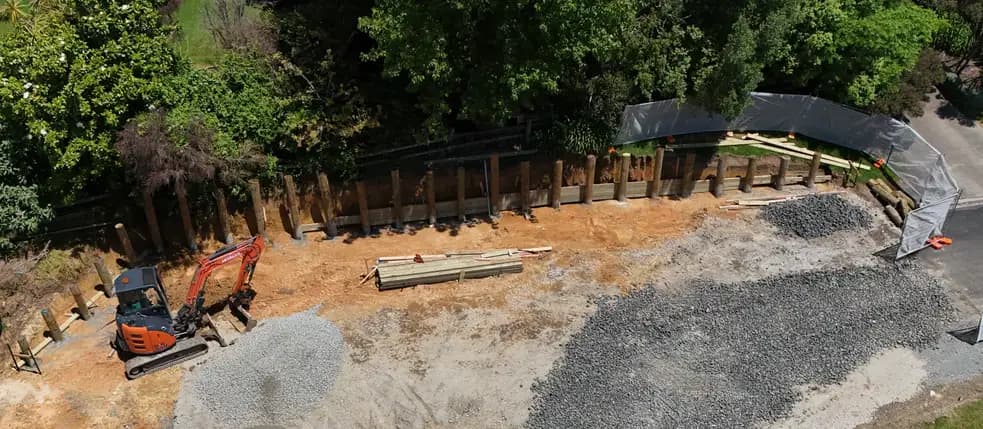
If you are planning a retaining wall on an Auckland property, one of the first questions is whether a building consent is needed. The answer depends on the depth of retained ground, any surcharge, and whether an exemption applies. This guide explains the exemptions, surcharge, engineering and the approval process. For pricing, see our retaining wall cost guide.
The 1.5 metre exemption
Under Schedule 1 of the Building Act 2004, building work in connection with a retaining wall may be exempt from building consent where it retains no more than 1.5 metres depth of ground and does not support surcharge or any load additional to the retained ground. The 1.5 metres refers to the depth of retained ground.
In practice:
- A wall retaining no more than 1.5 metres of ground with no surcharge may qualify for the exemption
- A wall retaining the same depth with a driveway or building above it may not qualify, because it supports surcharge
Walls outside the exemptions generally need to be assessed for building consent. Whether a particular wall qualifies should be confirmed for the site.
What counts as surcharge
Surcharge is any load on the ground behind the wall in addition to the retained ground itself. Examples can include:
- Vehicle driveways
- Parking areas
- Buildings
- Swimming pools
- Other retaining walls
- Sloping ground where it imposes additional load
Where surcharge is present, the wall needs to be designed for the additional load, which can involve an engineer.
The separate rural-zone exemption
There is a separate Schedule 1 exemption for certain retaining walls in rural zones. It applies where the wall retains no more than 3 metres depth of ground, the distance between the wall and any legal boundary or existing building is at least the height of the wall, and the design is carried out or reviewed by a Chartered Professional Engineer. The statutory definition of rural zone excludes rural residential areas.
This is not a general exemption for walls up to 3 metres, and it does not apply across all Auckland properties.
A building-consent exemption does not remove the need to comply with the Building Code or any separate planning, resource-consent or other legal requirements that apply to the site.
When engineering may be required
Where specific engineering design is required, the consent documentation may include engineer-designed drawings and supporting producer statements. The required design and completion documentation depends on the wall system, site conditions and Council requirements.
For a timber pole wall, the engineer's design may address pole size and grade, embedment, spacing, lagging and drainage. For a concrete block or poured concrete wall, it may address reinforcing, footings, drainage and tie-backs where applicable. Site specific geotechnical input may be requested where ground conditions are uncertain.
Ground conditions
Ground conditions vary across Auckland and between sites, and they affect wall design and construction. Variables can include:
- Clay soils, which can hold moisture and change volume with moisture content, so drainage behind the wall is an important consideration
- Rock close to the surface, which can make excavation more difficult
- Fill ground, which can be variable, so geotechnical input may be advisable before a wall is designed on fill
Site-specific ground conditions should be considered in the design and the construction method.
Drainage behind the wall
Managing groundwater and water pressure is an important part of retaining wall design. Drainage may include free-draining aggregate, geotextile, subsoil drainage, weepholes and proprietary drainage systems, depending on the wall design and site. The wall should be constructed to the drainage detail specified for the project.
Drainage requirements are not identical for every wall. See our drainage services for related works.
Boundary walls
Retaining walls on or near a property boundary can add complexity. Boundary position, ownership, fencing arrangements, easements and neighbour responsibilities can be site-specific, and surveying or legal advice may be needed. This guide does not give legal advice.
Where a wall is near a boundary, the consent and design process may need to account for the effect on the neighbouring property.
The consent and approval process
Depending on the project, the process can include the following steps.
- 01
Site review
The wall location, retained depth, any surcharge, ground conditions and boundary position are reviewed to work out whether an exemption may apply and what design information is needed.
- 02
Design and engineering where required
Where specific engineering design is required, an engineer produces the design for the wall. The required documentation depends on the wall design and Council requirements.
- 03
Building consent application where required
Where consent is required, an application is lodged with Auckland Council with the design information and any geotechnical input requested.
- 04
Council assessment
Council assesses the application, and timeframes can be affected by requests for further information. Consent conditions, including inspection requirements, may apply.
- 05
Construction and inspections
Construction follows the approved drawings, with Council inspections at the stages required by the consent.
- 06
Completion documentation
Where construction review forms part of the engineering scope, the engineer may provide a PS4 or other completion documentation required by the building consent.
- 07
Code Compliance Certificate where applicable
Where a consent has been issued, Council decides whether to issue a Code Compliance Certificate once its requirements are satisfied and the documentation is complete.
Not every wall follows every step. Council timeframes and decisions are outside Bromley Group's control.
Bromley Group's role
Bromley Group constructs retaining walls to approved drawings where applicable and coordinates construction activities. That includes site access for inspections where required, and providing construction information from our scope where required. We work with the engineer, surveyor, Council and project team where applicable.
Design, engineering certification and Council approvals remain with the engineer and Council.
Common mistakes
- Assuming an exemption applies without checking the depth of retained ground, surcharge and other requirements
- Not accounting for a driveway or structure above the wall when assessing surcharge
- Not allowing for drainage behind the wall in the design and the quote
- Backfilling before required inspections have taken place
- Not confirming boundary position before starting work near a fence line
Bromley Group builds timber, concrete block and engineered retaining walls for residential and commercial sites across Auckland. Excavation and site preparation for walls is covered in our site cut and site preparation guide. Discuss Your Project.
Frequently asked questions
Does my retaining wall need building consent?
It depends on the depth of retained ground, any surcharge and whether an exemption applies. A wall retaining no more than 1.5 metres of ground may qualify for an exemption where it does not support surcharge or any additional load. Walls outside the exemptions generally need to be assessed for building consent, and other requirements can still apply.
What does surcharge mean?
Surcharge is any load on the ground behind the wall in addition to the retained ground itself. Examples can include vehicle driveways, parking areas, buildings, swimming pools, other retaining walls and sloping ground where it imposes additional load.
Does a wall under 1.5 m always qualify for an exemption?
No. The exemption depends on the wall retaining no more than 1.5 metres of ground and not supporting surcharge or any additional load. A building-consent exemption also does not remove the need to comply with the Building Code or any separate planning, resource-consent or other legal requirements that apply to the site.
Can a retaining wall over 1.5 m ever be exempt?
A separate Schedule 1 pathway exists for certain walls in rural zones, retaining no more than 3 metres of ground, where the conditions described above are met, including engineer design or review. Otherwise the wall may need to be assessed for building consent.
When is an engineer required?
Where specific engineering design is required, the consent documentation may include engineer-designed drawings and supporting producer statements. The required design and completion documentation depends on the wall system, site conditions and Council requirements.
Does every retaining wall need drainage?
Managing groundwater and water pressure is an important part of retaining wall design. The drainage detail depends on the design, wall system and site, and there is no single detail that applies to every wall.
What happens if the wall is on a boundary?
Boundary position, ownership, fencing arrangements, easements and neighbour responsibilities are site-specific. Surveying or legal advice may be needed, and this article does not give legal advice.