
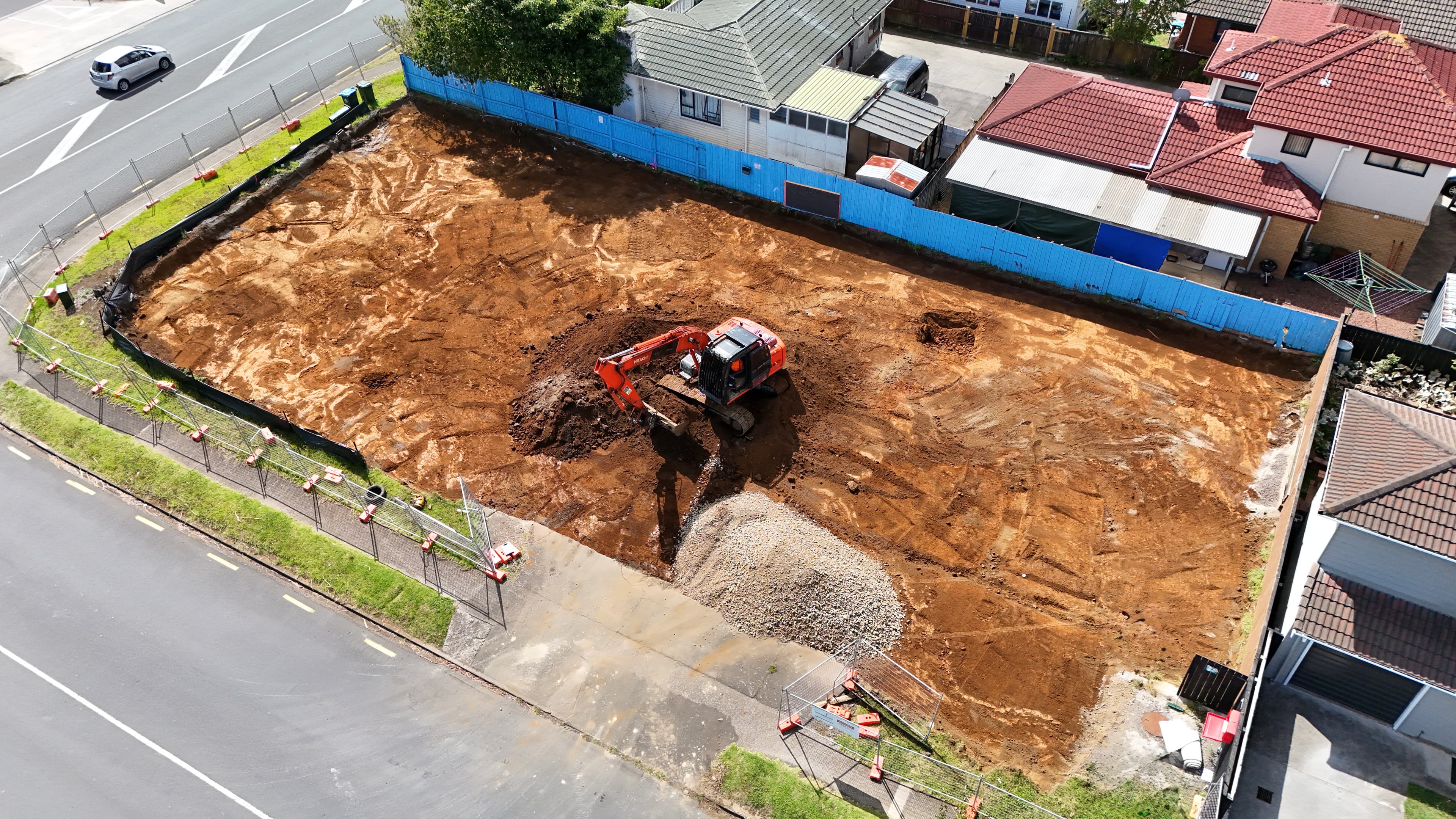
Site preparation is the stage where most build quality problems either start or are prevented. What happens below the surface before the first concrete truck arrives determines whether the structure above it performs for decades or begins failing within years. For Auckland builds, the local ground conditions make that statement more true than almost anywhere else in New Zealand.
Why Auckland site preparation is different
Auckland's ground conditions present a combination of challenges that are not common elsewhere in New Zealand. Civil contractors and developers working in Auckland face three primary site conditions, often in combination:
- Expansive clay soils that swell with moisture in winter and shrink in summer, creating seasonal movement at the surface and in fill layers
- Volcanic rock (basalt) in large parts of the North Shore, central Auckland, and Manukau that requires breaking equipment and significantly increases excavation time
- Historical fill over natural contours on many urban sections, with variable compaction quality and unknown composition that can hide voids or organic material
Each of these conditions changes the site preparation workflow in ways that contractors without local Auckland experience will not anticipate at the quoting stage. The result is either underpriced work with corners cut to protect margins, or mid-project scope variations that blow budgets.
The site preparation workflow
A complete site preparation sequence for an Auckland build follows these stages in order. Skipping or compressing any stage creates risk that compounds through every stage that follows.
- 01
Geotechnical investigation
Bore logs, test pits, or dynamic cone penetrometer testing establishes bearing capacity, groundwater depth, and the presence of any fill layers. This is the information on which every subsequent decision is based. Deferring it to save a few thousand dollars is the most common source of major cost surprises on residential and light commercial builds.
- 02
Topographic survey
Accurate existing levels across the full site boundary are required before cut and fill volumes can be calculated. Where GPS survey is used, confirm the datum is referenced to Auckland's local vertical datum to avoid level discrepancies at the foundation stage.
- 03
Stripping and clearing
Topsoil, vegetation root zones, and any organic material are stripped to the specified depth and either stockpiled for reuse in finished landscaping or removed from site. Organic material left beneath fill or slab areas will decompose and settle over time.
- 04
Cut and fill earthworks
Material is moved to achieve the design platform level. On sloped sections this involves establishing stable benches cut into the existing ground before any fill is placed. Fill is placed in compacted layers of 150 to 200mm maximum depth and tested to the specified compaction standard at each layer.
- 05
Subsoil and surface drainage
Drainage is installed at the earthworks stage, not retrospectively. Subsoil drains capture and discharge groundwater before it saturates fill layers. Surface drainage falls are cut into the platform so water sheds away from the building footprint. On clay sites, this step is as important as the compaction work itself.
- 06
Subgrade preparation and proof roll
The finished platform surface is trimmed, compacted, and proof rolled with a heavy machine to identify any soft spots that need further treatment. Any areas that deflect under proof rolling are excavated, treated, and recompacted before the subbase or foundation works begin.
Compaction standards and testing
Compaction is the most important and least visible part of site preparation. It is also the part most often reduced on cheaper jobs because no one can see it once the next layer goes down. The required compaction standard for residential building platforms in New Zealand is typically 95% modified proctor dry density. Key points to confirm with your contractor:
- Compaction testing should be carried out by an independent geotechnical engineer, not the earthworks contractor
- Test results should be provided in a written report with pass/fail results by layer and location
- Fill placement during heavy rain compromises compaction - confirm your contractor has a wet weather protocol
- On clay sites, moisture conditioning of fill material prior to compaction significantly improves outcomes and should be written into the specification
Note: Council or building consent conditions sometimes require a producer statement from a geotechnical engineer confirming that earthworks have been completed to the specified standard. Confirm this requirement before the earthworks contractor leaves the site.
How site preparation affects build quality downstream
Inadequate site preparation creates problems that do not appear immediately. The most common downstream consequences of poor site preparation in Auckland builds are:
- Foundation settlement: poorly compacted fill settles unevenly, causing cracking in slabs, walls, and cladding systems
- Subfloor moisture: drainage not integrated at the earthworks stage results in water accumulating under slabs and in subfloor cavities, accelerating timber deterioration
- Retaining wall movement: walls founded on uncompacted fill or without adequate drainage behind them move over time, compromising both the wall and the structure it supports
- Pavement and driveway failure: driveways and hardstand areas cracking within a few years are almost always traceable to subbase preparation, not the surface material
In each case, remediation after construction costs far more than doing the groundwork properly at the preparation stage. On Auckland's clay-heavy urban sections, the investment in a thorough site preparation programme is one of the highest-return decisions a developer or property owner can make.
For site preparation done properly from the start, talk to Bromley Group - an experienced earthworks contractor Auckland builders and developers rely on.
Bromley Group handles site preparation from geotechnical review through to final proof roll on Auckland residential and commercial builds. Get in touch for a site assessment.
Frequently asked questions
How long does site preparation take on an Auckland residential section?
A straightforward residential site preparation on a flat section typically takes two to five days. Sloped sections requiring cut and fill, retaining wall preparation, and drainage works can take two to four weeks depending on volume, access, and ground conditions. Geotechnical investigation and survey add time before earthworks begin and should be factored into the overall programme.
What is a proof roll and do I need one?
A proof roll is a quality verification step where a heavy vehicle is driven slowly across the prepared subgrade to identify any soft or poorly compacted areas. It is standard practice on commercial projects and should be required on any residential project where the foundation or floor slab relies on engineered fill. If the subgrade deflects under the roller, the soft areas must be excavated and recompacted.
Does site preparation require a building consent in Auckland?
Earthworks consent requirements under the Auckland Unitary Plan depend on the volume of material being moved, the slope of the site, and proximity to sensitive environments. Earthworks over certain thresholds require a resource consent. All earthworks involving sediment discharge must comply with Auckland Council's erosion and sediment control requirements regardless of consent status.
What questions should I ask a site preparation contractor before accepting a quote?
Ask specifically about subbase depth and compaction standard, whether independent compaction testing is included, how drainage is being managed during and after earthworks, and what the wet weather policy is. A contractor who cannot answer these questions in specific terms is not pricing the job correctly.