
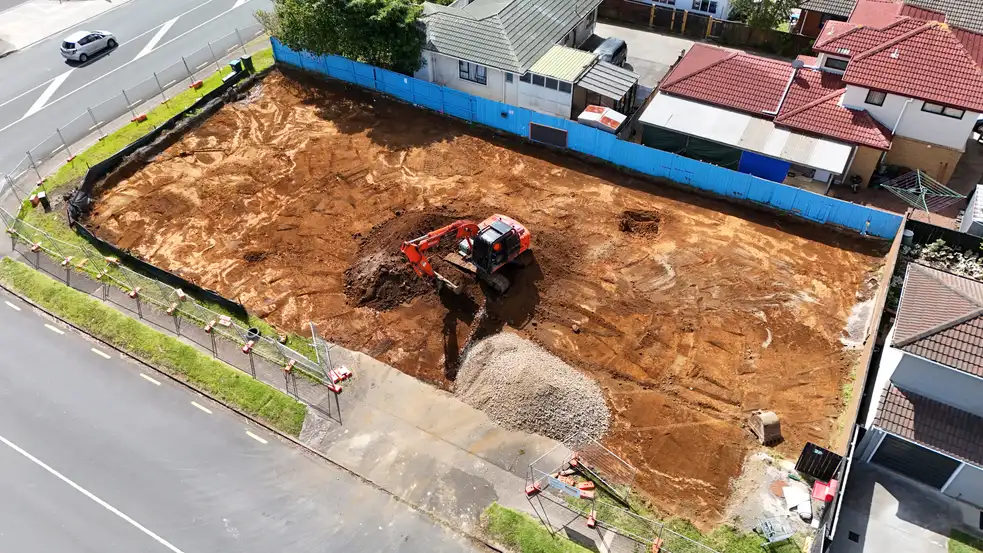
Subgrade preparation is the work that happens between bulk earthworks and whatever goes on top - a slab, a pavement, a driveway, or a building platform. The subgrade is the foundation the finished surface depends on. Get it wrong and you are looking at cracking, settlement, and remediation costs that dwarf what was saved on preparation. This guide explains what subgrade preparation involves in Auckland, what standards apply, and what questions to ask your contractor.
What is subgrade preparation?
The subgrade is the natural or imported soil layer that sits immediately beneath a pavement, slab, or building foundation. Subgrade preparation is the process of getting that layer to the right density, moisture content, and level before construction above it begins.
It typically follows bulk earthworks and site cut - once you are at or near design levels, subgrade preparation starts. The sequence is:
- 01
Proof rolling
A heavy roller or loaded truck makes passes across the prepared surface to identify soft spots. Areas that deflect or rut under the proof roller have inadequate bearing capacity and need treatment before anything goes on top.
- 02
Subgrade treatment
Soft or unstable areas are either stabilised in place (lime or cement stabilisation for clay subgrades) or excavated and replaced with imported fill or basecourse. The geotechnical engineer specifies which approach is appropriate for the ground conditions.
- 03
Fill or basecourse placement
Imported material is placed in compacted layers (lifts) to the design depth. Each lift is compacted before the next goes on. Trying to compact material that is too thick in one lift is a common cause of failing compaction tests later.
- 04
Compaction testing
Compaction acceptance criteria depend on the material, intended use, geotechnical recommendations and project specification. Testing may involve nuclear density testing, sand replacement or another approved method, with the required result assessed against the specification for that project. For engineered fill supporting lightweight structures, NZS 4431:2022 may apply where it is referenced by the design or consent documentation.
- 05
Sign-off documentation
Testing records are provided to the geotechnical engineer or building consent authority for their sign-off before construction proceeds.
Why Auckland's ground conditions make this critical
Auckland's geology is dominated by materials that make subgrade preparation more demanding than in many other regions.
Expansive clays
Ground conditions vary across Auckland, and clay is present in many areas, including parts of Remuera, Onehunga, Papakura, Kumeu and Flat Bush. Auckland clays have high plasticity, meaning they shrink when dry and swell when wet. A clay subgrade compacted at the wrong moisture content can appear to pass a density test but move seasonally under load. Cohesive fill generally needs to be placed within an appropriate moisture range for effective compaction. The acceptable range should follow the geotechnical specification or testing requirements for the project, and may require timing work around weather and sometimes drying or wetting the material before compaction.
Volcanic rock
Basalt underlies parts of Central Auckland, Epsom, Onehunga, and the North Shore. Where rock is close to the surface, proof rolling is irrelevant - the issue is getting to design levels through hard material. The challenge is the breaking and removal cost to get there.
Variable fill
Older Auckland sections often carry demolition rubble, uncontrolled fill, or poorly documented previous earthworks. Variable fill subgrades require more investigation and more conservative treatment than natural ground.
What goes wrong when subgrade preparation is skipped or rushed
The consequences are predictable and expensive:
- Pavement failure - cracking, rutting, and potholing in driveways and car parks on a poorly prepared subgrade
- Slab settlement and cracking - concrete floors that crack and settle unevenly, causing trip hazards, drainage problems, and structural concerns
- Building platform movement - differential settlement under foundations leading to cracking in walls and floors, and in serious cases, structural issues requiring underpinning
- Drainage failure - settled surfaces that no longer drain to design falls, causing ponding and water ingress
In every case the remediation cost is substantially higher than the cost of doing the subgrade preparation correctly in the first place. Most pavement failures in Auckland are a subgrade problem, not a surface problem.
Subgrade preparation for different applications
Building platforms
Building platform subgrade preparation is governed by the geotechnical engineer's report and the building consent conditions. Typically requires proof rolling, treatment of soft spots, compaction to the project specification, and a geotechnical engineer's sign-off before the slab or foundations are formed.
Driveways and pavements
Residential driveways require compacted subgrade plus basecourse to the depth specified for the pavement design. Aggregate type and depth vary with the approved design and site conditions. Commercial pavements are designed to traffic loading with greater basecourse depths. Skimping on basecourse depth is one of the most common causes of driveway failure in Auckland.
Subdivision roading
Subdivision roading is constructed to Auckland Transport standard or the consent conditions, which specify compaction percentages, basecourse depth, and testing frequency. Hold points with the council inspector must be passed before subsequent layers are placed.
Retaining wall foundations
Retaining wall foundations need a stable, well-compacted base. For engineered walls this is specified by the structural engineer. For timber walls it is typically cleared to firm ground and compacted - soft spots under post holes are a common cause of wall movement over time.
What to ask your contractor about subgrade preparation
Before signing off on any earthworks, paving, or slab quote, ask:
- Is proof rolling included and how will soft spots be treated?
- What compaction standard are you working to and how will it be tested?
- Are testing records included and who do they go to for sign-off?
- What is the basecourse depth and specification?
- How do you handle the job if conditions are too wet to compact?
A contractor who cannot answer these questions clearly is not managing the subgrade to a standard that protects your investment.
Bromley Group is an Auckland earthworks contractor carrying out subgrade preparation and foundation platform works for residential, commercial, and subdivision projects across Auckland. We work to geotechnical and engineering specifications and do not proceed with construction above until the subgrade meets the required standard. For site cuts and bulk earthworks that lead into subgrade preparation, see our site cut preparation guide and earthworks cost guide. Discuss Your Project.