
Construction tendering explained: guide for Auckland civil projects
- Jay Price
- 2 days ago
- 7 min read

TL;DR:
Construction tendering in Auckland focuses on value, methodology, and compliance, not just low price.
The process involves detailed scope, documentation, and evaluation criteria including safety, experience, and approach.
Matching tendering method to project complexity and building strong contractor relationships are key to success.
Winning a civil construction tender in Auckland is rarely about submitting the lowest price. Property developers and project managers often assume that cost drives every decision, but experienced contractors know that evaluation panels weigh methodology, track record, and compliance just as heavily. The tendering process is also far more structured than many developers expect, governed by formal standards and local procurement rules that can catch unprepared teams off guard. This guide walks you through what construction tendering actually involves, how the process unfolds, and what to watch for on Auckland civil projects.
Table of Contents
Key Takeaways
Point | Details |
Understand the tendering process | Construction tendering involves structured competition, weighted evaluation, and must comply with NZS 3910:2023 for Auckland civil works. |
Choose the right method | Open, selective and negotiated tendering serve different project needs and risks—match the method to your project’s complexity. |
Document scope and expectations | Clear, detailed documentation and defined scopes are crucial to avoiding disputes and quality issues. |
Navigating compliance | Government rules now require tenders to demonstrate local economic benefits and separate contract administration roles. |
What is construction tendering?
Construction tendering is the formal process where project owners invite contractors to submit competitive bids. For civil projects, it serves a clear purpose: create fair competition and identify the contractor offering the best overall value, not just the cheapest price. Construction tendering assesses price, methodology, experience, and compliance with standards like NZS 3910:2023 for building and civil engineering in New Zealand.
In a typical Auckland civil project workflow, tendering sits between design sign-off and contract execution. Once a scope is confirmed and consents are progressing, the project owner issues tender documents to the market. Contractors then prepare and submit bids within a set timeframe, usually two to six weeks depending on project complexity.
Here is what a civil construction tender package typically includes:
A scope of works describing site conditions, deliverables, and any constraints
Pricing schedules broken into trade or work packages
A programme showing key milestones and completion dates
Methodology statements explaining how the contractor will approach the work
Evidence of relevant certifications, insurance, and health and safety systems
References or case studies from comparable civil construction projects
“The tendering process is not just a pricing exercise. It is a capability assessment disguised as a pricing exercise.” This distinction matters enormously when you are selecting a contractor for earthworks, drainage, or concrete infrastructure in Auckland.
The industry tendering process also shapes how contractors invest in their businesses. Firms that tender regularly tend to maintain better documentation systems, tighter cost controls, and clearer internal processes, all of which benefit clients directly.
Key steps in the civil tendering process
The civil tendering process in Auckland follows a consistent pattern, even if timelines and complexity vary by project size.
Identify the opportunity via portals like GETS (Government Electronic Tender Service) or through direct invitation from a developer or head contractor
Review tender documents carefully, noting scope inclusions, exclusions, site access constraints, and any Auckland Council or Watercare requirements
Prepare your submission with pricing schedules, a detailed works methodology, programme, and all required certifications
Submit before the deadline through the nominated portal or in hard copy, as late submissions are typically rejected outright
Evaluation and clarification where the client may request queries, interviews, or site walks before making a decision
Contract award under the applicable form, most commonly NZS 3910:2023 for civil engineering work in New Zealand
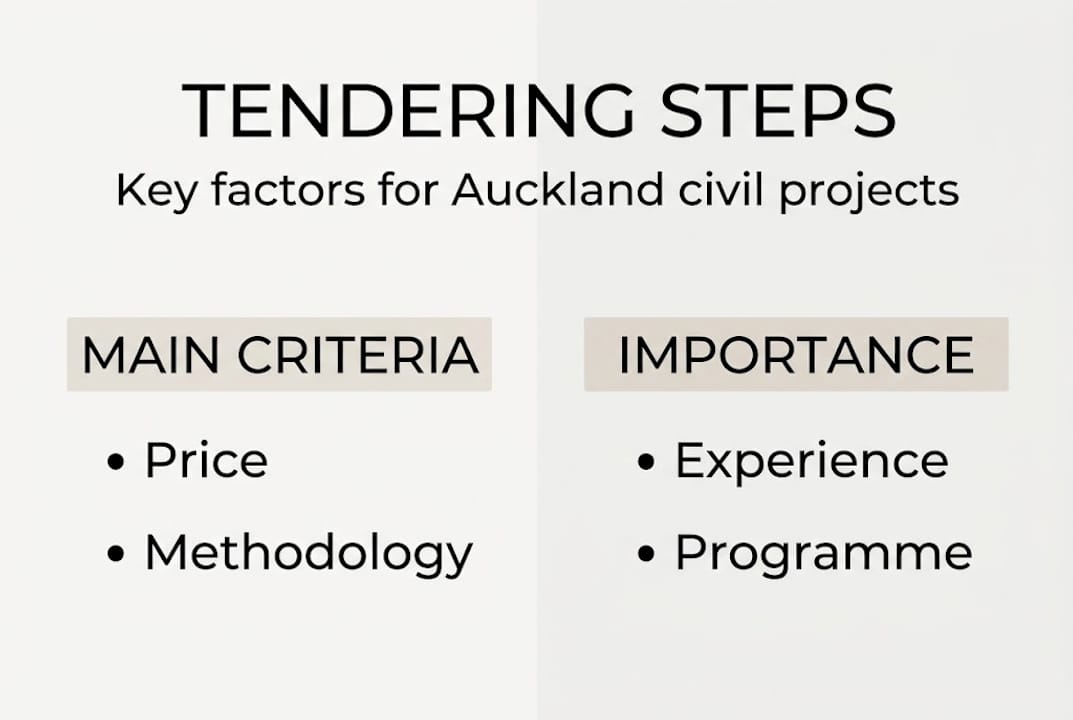
Evaluation criteria are usually weighted across multiple factors. Here is a typical breakdown for Auckland civil tenders:
Criterion | Typical weighting |
Price | 40% to 60% |
Methodology and programme | 20% to 40% |
Experience and track record | 10% to 20% |
Health, safety, and risk | 5% to 15% |
These evaluation weightings confirm that cost is important but rarely the only deciding factor. Strong methodology and documented experience can compensate for a slightly higher price on complex jobs.
Pro Tip: Treat the methodology statement as your opportunity to demonstrate site-specific thinking. Generic responses are easy to spot and typically score poorly. Tailoring your approach to the actual site conditions in your submission signals competence and reduces a client’s perceived risk. Strong project planning sets capable contractors apart early.
Main tendering methods used in Auckland
Not all tenders are structured the same way. The method you choose, or are invited into, shapes everything from the competitive field to the quality of bids you receive.
Open tendering invites any contractor to submit a bid, usually through a public portal like GETS. It generates maximum competition and can reduce bid costs by around 12% on average, but it also floods clients with 10 to 20 submissions of varying quality, making evaluation time-consuming.
Selective tendering involves pre-qualifying a shortlist of contractors before inviting bids. This narrows the field to firms with demonstrated capability, reducing evaluation burden and lifting overall submission quality. It is commonly used for managing complex commercial projects where contractor capability is critical.
Negotiated or Early Contractor Involvement (ECI) tendering brings one or two contractors into the project before design is finalised. This suits complex civil jobs where buildability input, supply chain relationships, or tight timelines make early collaboration essential.
Method | Best for | Key risk |
Open | Straightforward, price-driven work | High evaluation volume, inconsistent bids |
Selective | Quality-focused, mid-complexity projects | Requires robust pre-qualification |
Negotiated/ECI | Complex civil, specialist or time-critical | Less competitive pricing tension |
Pro Tip: Match your tendering method to project complexity before going to market. A negotiated approach on a straightforward drainage job wastes time. Open tendering on a technically complex retaining wall system risks landing a contractor who cannot deliver. Refer to the full tendering guide for further detail on pre-qualification frameworks.
Nuances, local rules, and common pitfalls
Even well-structured tenders run into problems. In Auckland, a few recurring issues catch developers and project managers off guard.
Bid inconsistencies and scope assumptions are common in open tenders. A single concrete package in Auckland generated 14 quotes with varying assumptions, making direct comparison almost impossible. Poorly defined scopes invite contractors to fill gaps with their own interpretations, which almost always leads to variation claims later.
Lowball bids are particularly risky on civil work. A contractor who wins on price but has underpriced the job will look for variations, cut corners on materials, or slow down when cash flow tightens. Engaging capable civil subcontractors from the start, rather than rewarding the cheapest bid, protects your programme and your budget.
NZS 3910:2023 introduced a significant structural change: the traditional Engineer role is now split into a Contract Administrator handling day-to-day decisions and an Independent Certifier managing payment claims and disputes. This separation is designed to reduce conflicts of interest, but it adds a layer of coordination that project teams need to plan for.
2026 procurement rules for public projects now require economic benefit weightings in tender evaluations, meaning NZ content, local employment, and supply chain commitments carry formal scoring weight alongside price.
Building costs in Auckland continue to edge higher into 2026, driven by rising timber and cladding prices. This context matters when setting bid price expectations and assessing whether an unusually low submission is realistic.
A fresh perspective: tendering in Auckland civil projects
Most guides focus on process steps. What they miss is the strategic reality for Auckland developers: the best civil contractors are not always chasing your tender. Experienced firms with strong pipelines can afford to be selective. If your tender documents are vague, your timeline is compressed, or your scope has obvious gaps, capable contractors will simply move on.
The developers who consistently attract quality bids invest in accurate, detailed scopes before going to market. They close the feedback loop with unsuccessful tenderers to improve future processes. While open tendering saves around 12% on bids, the time and risk cost of evaluating 15 inconsistent quotes often erodes those savings entirely.
Pro Tip: Build relationships with contractors who ask good questions during tender. A contractor who queries assumptions or flags scope gaps before submitting is showing you exactly how they will behave on site.
Expert support for your next Auckland tender
Navigating Auckland’s civil tendering landscape is easier when you have a contractor who understands both the process and the on-the-ground realities of local projects.
[
Bromley Group works with property developers and project managers across Auckland on earthworks, drainage, concrete construction, and small-to-medium civil infrastructure. Whether you need help understanding what your project scope should include or want a competitive quote from an experienced team, we make the tendering process straightforward. Explore our earthworks contracting services or request a quote to get started.
Frequently asked questions
What documents are required for a civil construction tender in Auckland?
You will generally need detailed pricing, a works methodology, timelines, relevant certifications, and evidence of past experience, all aligned with NZS 3910:2023 requirements. Incomplete submissions are commonly disqualified at the initial review stage.
How are civil construction tenders evaluated in Auckland?
Evaluation typically weighs price at 40 to 60%, quality and methodology at 20 to 40%, with additional scoring for experience, programme certainty, and health and safety systems.
What’s the main risk with accepting the lowest bid?
Low bids can lead to quality reductions or a surge in variation claims once work begins, particularly when the scope is not watertight. Careful scope definition and contractor vetting are your best protection.
What is NZS 3910:2023 and why is it important?
NZS 3910:2023 is the standard contract for building and civil engineering in New Zealand. It now separates contract administration from independent certification, reducing conflicts of interest and improving dispute resolution on civil projects.
Recommended