
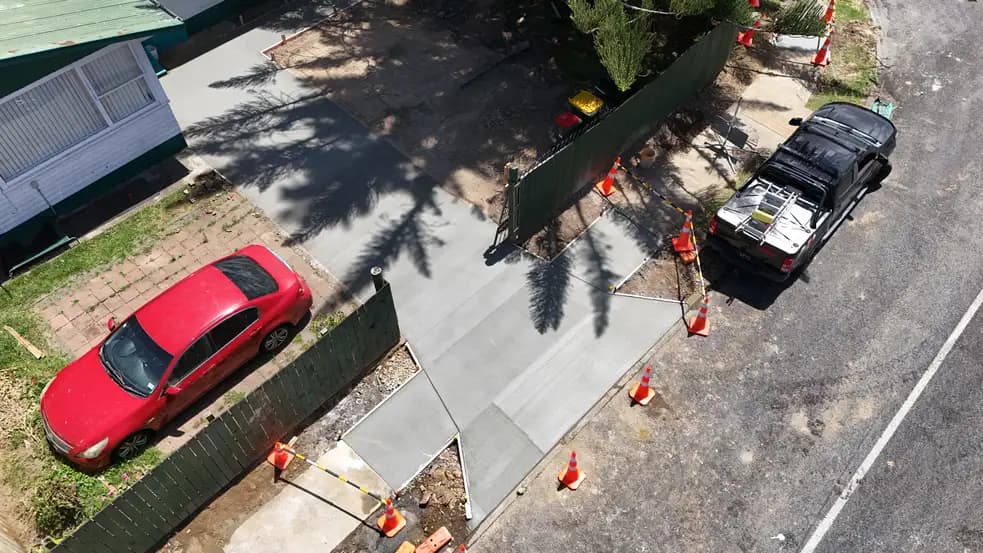
Most concrete driveway quotes you receive will be priced per square metre. That number is useful, but it only covers the slab. What sits underneath it is usually where the real cost sits, and it is also where the difference between a driveway that lasts thirty years and one that cracks in three is decided.
This guide covers current Auckland rates, what drives them, and what to check before you sign anything.
What does a concrete driveway cost in Auckland?
Typical 2026 Auckland rates, supplied and laid:
Rate per square metre
- Plain or broom finish: $100 - $160 per square metre
- Coloured concrete: $110 - $150 per square metre
- Exposed aggregate: $150 - $250 per square metre
- Stamped or patterned: $130 - $190 per square metre
Typical job totals
- Single-car driveway, around 30 to 40 square metres: $4,000 - $8,000
- Standard residential driveway, around 50 to 60 square metres: $6,000 - $12,000
- Larger driveway or shared accessway, 100 square metres and above: $12,000 - $30,000
These figures generally exclude significant site preparation, drainage work, and vehicle crossing formation. In many cases those are the items that move a quote most.
What actually drives the cost
- 01
The groundwork underneath
This is the item most homeowners underestimate and the one that separates quotes more than the finish does. A concrete driveway needs a stable, compacted base. On most Auckland sites that means excavating to depth, removing unsuitable material, placing and compacting basecourse, and getting the subgrade right before any concrete is ordered. Where the existing ground is soft, wet, or made up of uncontrolled fill, more of it has to come out and more basecourse goes in. If one quote is noticeably cheaper than the others, this is usually where the difference is. Ask what depth of basecourse is allowed for and how the subgrade will be prepared.
- 02
Auckland's clay
Most of Auckland sits on reactive clay that shrinks in dry weather and swells when wet. Concrete laid over a poorly prepared clay subgrade moves with it, and that movement shows up as cracking, usually within the first few years. Managing it properly means compacting at the right moisture content, allowing adequate basecourse depth, and using appropriate reinforcement. It adds cost upfront and avoids a much larger cost later.
- 03
Removing the existing driveway
Breaking out and disposing of an existing concrete or asphalt driveway typically adds $2,000 to $6,000 depending on area, thickness, reinforcement, and disposal distance. Reinforced concrete takes longer to break out than plain.
- 04
Thickness and reinforcement
A standard residential driveway is usually around 100mm thick with steel mesh reinforcement. Anything carrying heavier vehicles, a truck, a boat, a caravan, or regular commercial traffic, needs to be thicker with heavier reinforcement, and that adds cost across the whole area.
- 05
Finish
Plain broom finish is the most economical. Exposed aggregate, colour and stamped patterns add material cost and significantly more labour and finishing time, which is why the rate roughly doubles at the top end.
- 06
Site access
A flat site with clear truck access to the pour is straightforward. A steep section, a narrow right of way, or a job where concrete has to be pumped rather than poured directly all add cost.
- 07
Drainage and vehicle crossing
New driveways often need surface drainage such as a channel drain, and a new or altered vehicle crossing where the driveway meets the road requires Auckland Council or Auckland Transport approval. Both are frequently excluded from headline quotes. Ask specifically whether they are in or out.
What should be in a concrete driveway quote
- Removal and disposal of the existing surface where applicable
- Excavation to depth and disposal of spoil
- Basecourse supply, placement and compaction, with the depth stated
- Formwork and steel reinforcement, with mesh specification stated
- Concrete supply and placement, with thickness and strength stated
- Finish type
- Control joints and their spacing
- Surface drainage where required, or a note that it is excluded
- Vehicle crossing works, or a note that they are excluded
- Reinstatement of surrounding ground
A quote that gives you a rate per square metre and nothing else is not a quote you can compare against another. Ask for the breakdown. If vehicle crossing works are excluded, see our vehicle crossing cost guide to see what that side of the work typically adds.
Concrete or asphalt?
Both work well when the base underneath is right. Concrete costs more upfront, typically lasts longer, and offers more finish options. Asphalt is usually cheaper per square metre, goes down faster, and suits larger areas and sloped sites well, though it generally needs resurfacing sooner.
We lay both, so we have no reason to push you toward one. See our asphalt vs concrete driveway comparison for a full breakdown.
Getting an accurate quote
No contractor can price a driveway properly from a photo. Useful information to have ready:
- Approximate area in square metres
- What is there now and whether it needs removing
- What will use it, cars only or heavier vehicles
- Whether the vehicle crossing is being changed
- Any known drainage problems or wet areas
- Access for trucks and machinery
We are the concrete contractor Auckland homeowners and builders turn to for the full scope, not just the slab. We do the earthworks, the basecourse, the drainage and the concrete as one scope rather than coordinating separate trades. The groundwork is not something we subcontract or gloss over in a quote, because it is the part that determines whether the driveway lasts, and it is exactly what our subgrade preparation guide covers in more detail. Get in touch for a free site visit and quote - we respond within one business day.